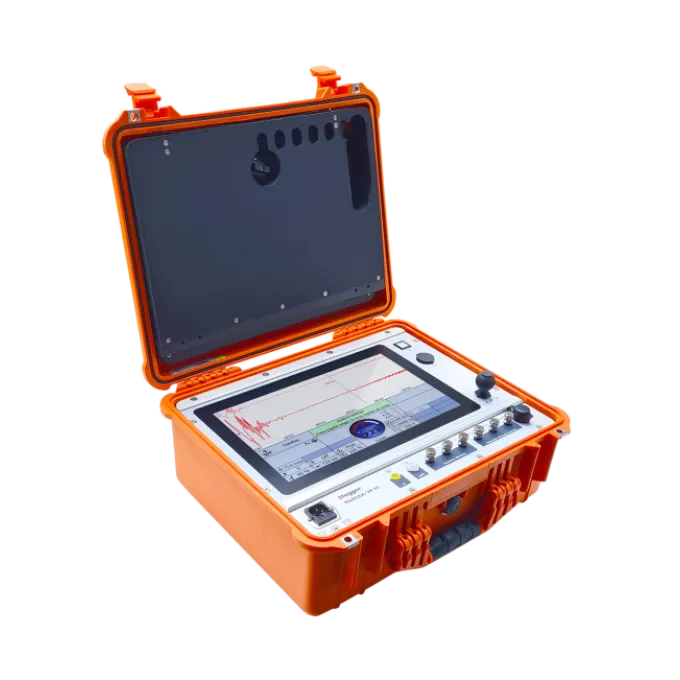
CFL535G dual-channel time domain reflectometer
Locate high and low impedance faults on telecom cables with an advanced time domain reflectometer
Locate high and low impedance faults on telecom cables with an advanced time domain reflectometer
Key Benefits
- Dual-channel capability for testing simultaneously on two phases
- “Auto set-up” mode for instant use
- Ultra fast pulse for near-end fault location
- Compare a good circuit with a faulty one to make the results easier to interpret
Description
The CFL535G time domain reflectometer (TDR) offers compatibility with virtually all types of paired metallic cables, comprehensive dual-channel operation, “auto set-up” for instant use, excellent near-end fault location performance, and internal storage for up to 100 traces. This instrument is ideal for rapidly, reliably, and conveniently locating cable faults in telecommunications systems. Directional control buttons and soft keys that aim to make operating the instrument easy and intuitive complement its large high-resolution WVGA colour display. Dual cursors allow instant measurement of the distance between any two points on the traces. Meanwhile, the trace comparison feature makes it easy to spot even slight differences between two simultaneously displayed traces. To ensure precise fault location, the CFL535G has a minimum resolution of just 0.1 m, and its maximum range is up to 20 km, depending on the type of cable and velocity factor selected. Velocity factors from 0.2 to 0.99 are supported, allowing the instrument to deliver accurate results with any cable type. A choice of five output impedances from 25 Ω to 125 Ω is offered, together with an automatic impedance matching function. The time-saving “auto set-up” option automatically sets the most suitable operating parameters for the instrument depending on the range selected, aiding rapid fault diagnosis. However, you can easily override the automatic settings, allowing you to manually fine-tune the operation of the instrument when dealing with particularly challenging faults. Megger’s unique “Xpert” mode is another invaluable aid to fault location. A single press of the “Xpert” key automatically adjusts the range and gain of the instrument, and positions the cursor over the first major event on the cable. Subsequent key presses move the cursor, one event at a time, to the positions of other major events on the cable. Compact, yet robustly built, the CFL535G dual-channel TDR has an IP54 ingress protection rating, which means that it is well protected against the vagaries of on-site use. It has CAT IV 150 V and CAT III 300 V safety ratings, in line with IEC 61010-1. We supply Megger’s TraceXpert PC software as a standard issue with every CFL535G. Designed around a powerful database and configured for ease of use and simplicity, this versatile software package gives users complete control over data download from the instrument and provides robust reporting facilities.
Frequently Asked Questions
When it comes to range limitations, is it true that TDRs can’t locate faults close to the point where they are connected to the cable?
While this used to be a problem, with good quality modern TDRs, it isn’t any longer. The latest instruments use very short pulses for so-called near-end measurements, which means they can accurately locate faults as close as a few centimetres from the point of connection.